
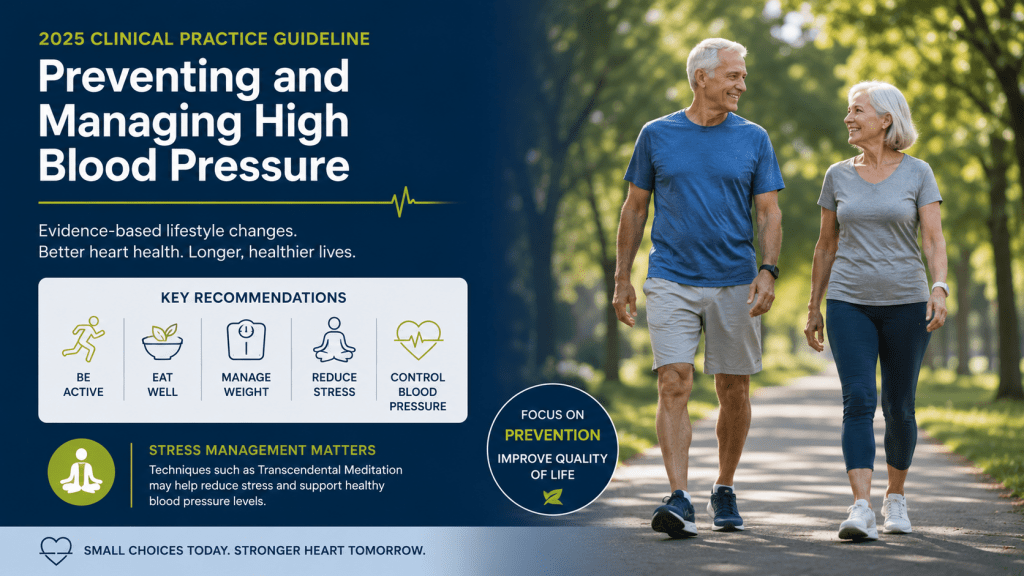
High blood pressure remains one of the greatest preventable causes of heart attack, stroke, heart failure and kidney disease. For decades, doctors have encouraged healthier eating, regular exercise, weight management and stopping smoking. Today, another recommendation has joined that list.
In 2025, the American Heart Association (AHA) and the American College of Cardiology (ACC), together with eleven other leading medical organisations, included Transcendental Meditation (TM) as a stress-reduction approach that may be reasonable, alongside lifestyle measures or medication where appropriate, within their clinical guideline for preventing and treating high blood pressure.
This raises an obvious question.
What changed between the cautious recommendation of 2013 and the stronger guidance in 2025?
The 2013 Position
After reviewing the available evidence, the American Heart Association concluded that Transcendental Meditation could be considered in a clinical setting to help reduce blood pressure.
Importantly, the reviewers examined several forms of meditation. Their conclusion was that TM was the only meditation technique with sufficient scientific evidence to justify a clinical recommendation. The evidence for mindfulness and other approaches was considered encouraging but too limited and inconsistent to support the same recommendation.
That was an important milestone, but it was still a cautious one.
Twelve More Years of Research
Between 2013 and 2025, considerably more research became available.
Randomised controlled trials and long-term follow-up studies continued to demonstrate that regular TM practice lowers blood pressure in people both with and without hypertension. Average reductions of around 5 mmHg systolic and 2 mmHg diastolic may appear modest, yet across whole populations they are associated with meaningful reductions in heart attack and stroke risk.
Researchers also gained a better understanding of how chronic stress contributes to cardiovascular disease. Long-term activation of the body’s stress response affects blood pressure regulation, inflammation, blood vessels and metabolic health.
Rather than viewing hypertension simply as a problem of the circulation, modern medicine increasingly recognises that psychological stress is one of the important drivers of cardiovascular disease.
The 2025 Guideline
The new guideline continues to recommend the familiar lifestyle measures:
- maintaining a healthy weight
- following a heart-healthy diet such as DASH
- reducing salt intake
- regular physical activity
- limiting alcohol
- managing stress.
Within the stress-management section, the guideline states that stress reduction through Transcendental Meditation may be reasonable to prevent or treat elevated blood pressure and hypertension when used alongside lifestyle measures or medication where appropriate.
The guideline also reviews breathing techniques and yoga, but concludes that the evidence supporting these approaches is less robust and more variable than that available for TM.
In other words, TM is not presented as a replacement for medical care. It is recommended as one component of a comprehensive prevention strategy.
Does the Guideline Recognise the Role of Stress?
Yes.
One of the most significant developments in the 2025 guideline is its explicit recognition that managing stress forms part of preventing and treating hypertension.
For many years, stress was widely acknowledged by patients but received relatively little emphasis in formal hypertension guidelines. Today, accumulating scientific evidence has strengthened the case that chronic psychosocial stress contributes to elevated blood pressure and increased cardiovascular risk.
The inclusion of a specific recommendation for stress reduction reflects this changing understanding.
What Does This Mean for Patients?
The message is straightforward.
No single lifestyle measure is enough on its own.
A healthy diet remains important.
Exercise remains important.
Weight management remains important.
Medication remains essential for many people.
But the guideline now also recognises that reducing chronic stress deserves a place alongside these established measures. For people seeking a scientifically studied meditation programme, the evidence supporting Transcendental Meditation has grown sufficiently for it to be specifically included within the AHA/ACC guideline.
That represents a remarkable shift from where the profession stood just over a decade ago.
Looking Ahead
Medicine continually evolves as evidence accumulates. The journey from the cautious recommendation in 2013 to the stronger 2025 guideline illustrates how clinical practice changes when high-quality research continues to produce consistent results.
For people interested in protecting both heart health and quality of life, this development marks an important recognition that caring for the mind and caring for the heart are closely connected. Explore Transcendental Meditation, wellbeing and health, read our detailed summary of Study H-01 on cardiovascular disease, or visit Research & Evidence for the wider evidence base.